
If It's Not One Thing, It's Another

If it’s not one thing, it’s another.

It’s one thing to be told that there is trouble ahead, but another thing altogether to find yourself in the midst of that trouble.

It’s one thing to say there’s paradox to be encountered on the Christian journey, but another thing to come face to face with that paradox.

It’s one thing to say you want to follow Jesus, but another thing to take up your cross and follow him.

It’s one thing to say you want to save your life, but another thing altogether to be willing to lose it for the sake of Jesus and his gospel.

Most of us would rather gain the whole world - or at least a little part of it, and risk losing our life in the process.  What would it profit us?  Well, could we have a minute to look at the numbers?

When God made a covenant with Abraham that he would be the “ancestor of many nations,” Abraham did not really believe God.  After all, if it was not one thing, it was another.  It was one thing to be told to leave your home and go wander; but another thing to remain childless, when all you wanted was a child.  So uncertain were Abraham and Sarah about the faithfulness of God that they had agreed that Abraham should father a son with another woman, (with Hagar, an Egyptian slave girl), just in case.  It’s one thing for God to tell you that you will be the father of many nations, but it’s another thing to believe it, when as yet you have no offspring.

But the thing about the covenant that God had established with Abraham was that it was mostly about God’s promises; not much was required of Abraham: only the commitment to the sign of the covenant (male circumcision), and faith (confidence that God would do as God had promised).  Still, it’s one thing to say you want to keep a covenant, but another thing to actually go through with the circumcision, and to do so from generation to generation.

Everybody knows that if it’s not one thing, it’s another.  But God calls his people into a covenant of love, and he says, “It’s not one thing or another, it’s just about faithfulness and love: I pledge my faithfulness and love to you, and you pledge your faithfulness and love to me.”

Jesus came into the world with the same mission: to establish God’s covenant of love.  But it’s one thing to lead your people to a promised land, and other to bring salvation to all the world.  And the thing about the covenant of the Cross is that it, too, is mostly about God’s promises: that you will gain your life if you take up your cross and follow Jesus.  Scary as the terms of this covenant sound, in actual practice, Jesus is the only one who ever had to carry a Cross.  Jesus is the only one who was ever nailed to a Cross.  Jesus is the only one who died on the Cross.  It’s really the “following” part that Jesus was asking us to take up.

It’s one thing to tell people they have to carry their cross, but it’s another thing to go to Calvary.

As it turns out, it’s one thing to say you are going to follow Jesus, but another thing to go with him all the way to the end.  

It’s one thing to say that he had come to bring life and to bring it abundantly, but another thing to deliver on that promise, especially right there, in shadow of death.

Ironically, faith has often been easier for those who live closer to death, easier for those who have little than it is for those who have much.  Turns out, it’s one thing to hope for the promises of heaven when the world isn’t giving you much, but it’s another thing to put your trust in God when you are doing pretty darn well on your own.

Like Abraham and Sarah, often, we don’t really believe that God can save our lives.  We are not even sure we need to be saved.  It’s one thing to say we want to follow Jesus, but another thing to decide we want to deny ourselves.  Is this even healthy psychologically?

It’s one thing to engage in self-denial out of shame, but another thing to put the self aside out of love.  Paradoxically, Jesus does not call for a self-denial that springs from shame, which only makes you smaller.  He calls for self-denial that springs from love, which makes you grow.

Well, it’s one thing to talk about self-denial, but another thing to do it.  It’s one thing to diet, but it’s another thing to fast.

It’s one thing to go to church, and maybe even to quite like doing so, but it’s another thing to let Jesus take over your life.

Jesus said that it’s one thing to turn a profit, but another thing to live a life, and that the two goals are often at odds with one another.  Jesus knew, I suppose, that it’s one thing to make a profit, but another thing to share it.  And look how hard it is for us to share - even the communists can’t do it very well.

So Jesus said, don’t build your life around the idea of profit.  Instead, build your life around the idea of sacrifice.  The goal of sacrifice is not to give up something that you would rather not give up.  The goal of sacrifice is to make life holy.  To make life holy, you end up giving up things that you want to give up, because it is only in giving them up that life turns to holiness; and in holiness there is beauty to be found; there is peace to found; and there is love to be found.

It’s one thing to gather up much for yourself, but it’s another thing to share it with those who are in need.

It’s one thing to serve a feast to your family and friends, but it’s another thing to feed the hungry who live on the streets.

It’s one thing to feed the hungry who live on the streets, but it’s another thing to call them your family, your friends.

You see, if it’s not one thing, it’s another.

We live in a world in which it’s increasingly difficult to know whether something is one thing or another.  Very little is what it appears to be anymore, and almost everything disappoints, eventually.  Even worse, many things don’t just disappoint, they will hurt you, too.

Before his disciples even knew about the Cross, Jesus began to prepare them to see that it would always be only one thing, even though to them it appeared to be one thing, not another.  A cross appeared to be only the way way of death, but his Cross would be the way of life

Paradoxically, the Cross neither disappoints nor hurts us.  Easy for me to say.  It was one thing for Jesus to go to the Cross, but another thing for us to do so.  Because the Cross was an instrument of shame and death for Jesus; but a sign of life and hope for us.

This is what Jesus does: he takes one thing and makes it another.

It’s one thing to say that no man has greater love than to lay down his life for his friends, but it’s another thing to give your life for the salvation of the world.

Yes, it’s one thing to believe that Jesus saved us by the power of his Crucifixion and his Resurrection, but another thing to know or understand exactly how that happened, which is pretty much beyond our ken.  There is always a reason not to believe, not to have faith.  Just ask Abraham and Sarah.  If it’s not one thing, it’s another.

Jesus takes one thing and makes it another.  He takes my life of sin and turns it into a song of hope.

You already know that, in this life, if it’s not one thing, it’s another.  So why not  put your trust in the one who turned the Cross into a sign of victory; who took one thing and made it another?

Jesus takes one thing and he makes it another.  He took water and turned it into wine.  He took the blind and gave them sight; the lame the deaf, the sick, and the sinful, and restored them to health.  He took a scant few handfuls of this and that and made it enough to feed a throng.  He took one thing and made it another.

He took fishermen and made them apostles.  He took outcasts and made them friends.  He took the weak and made them strong.  He took mourners and made them sing for joy. He took a storm and made it calm.

If it wasn’t one thing, it was another.  He took bread and made it his Body.  He took wine and made it his Blood.

He took the Cross, which could only ever kill him, and he made it an instrument of life.

And it turns out that it’s not one thing, it’s another, when he says to us, “Take up your cross and follow me.”  It’s not a sentence to carry a load that is heavy, painful, and dreary; it’s an invitation to dance.

It was one thing to suffer and die on the Cross, but it was quite another to rise from the dead.

It was one thing to defeat death for himself, but another thing to do it for us too, and to harrow Hell in the process, beating down Satan under his feet.

It was one thing to be among us in resurrected glory for forty days, but it is another thing to reign in heaven, where our true citizenship awaits us, and where sorrow and pain are no more, neither sighing, but life everlasting.

It was one thing to carry his Cross through the streets of old Jerusalem, but it is another thing to build a new Jerusalem: the only real city of hope, where a river runs through the streets of the city to make all things new.

If it’s not one thing, it’s another.  And that’s the thing about the Cross: it’s not one thing, it’s another; it’s not despair, it’s hope; it’s not darkness, it’s light; it’s not death, it’s life.  It’s not one thing, it is very, very much another.

Every day, if it’s not one thing it’s another.  But with the Cross before you, following Jesus, it’s not bad news, it’s good news.

Jesus said, “If any want to become my followers, let them deny themselves and take up their cross and follow me. For those who want to save their life will lose it, and those who lose their life for my sake, and for the sake of the gospel, will save it.”  And like the Cross, which looks like one thing, but is quite another, when Jesus is done with it, so too, is this call to lose your life for Jesus’s sake.

How can it be good news, when it sounds so hard, so difficult, so unlikely to get me what I want?

Well, it’s not one thing, it’s another.  Thanks be to God!


Preached by Fr. Sean Mullen
28 February 2021
Saint Mark’s, Locust Street, Philadelphia
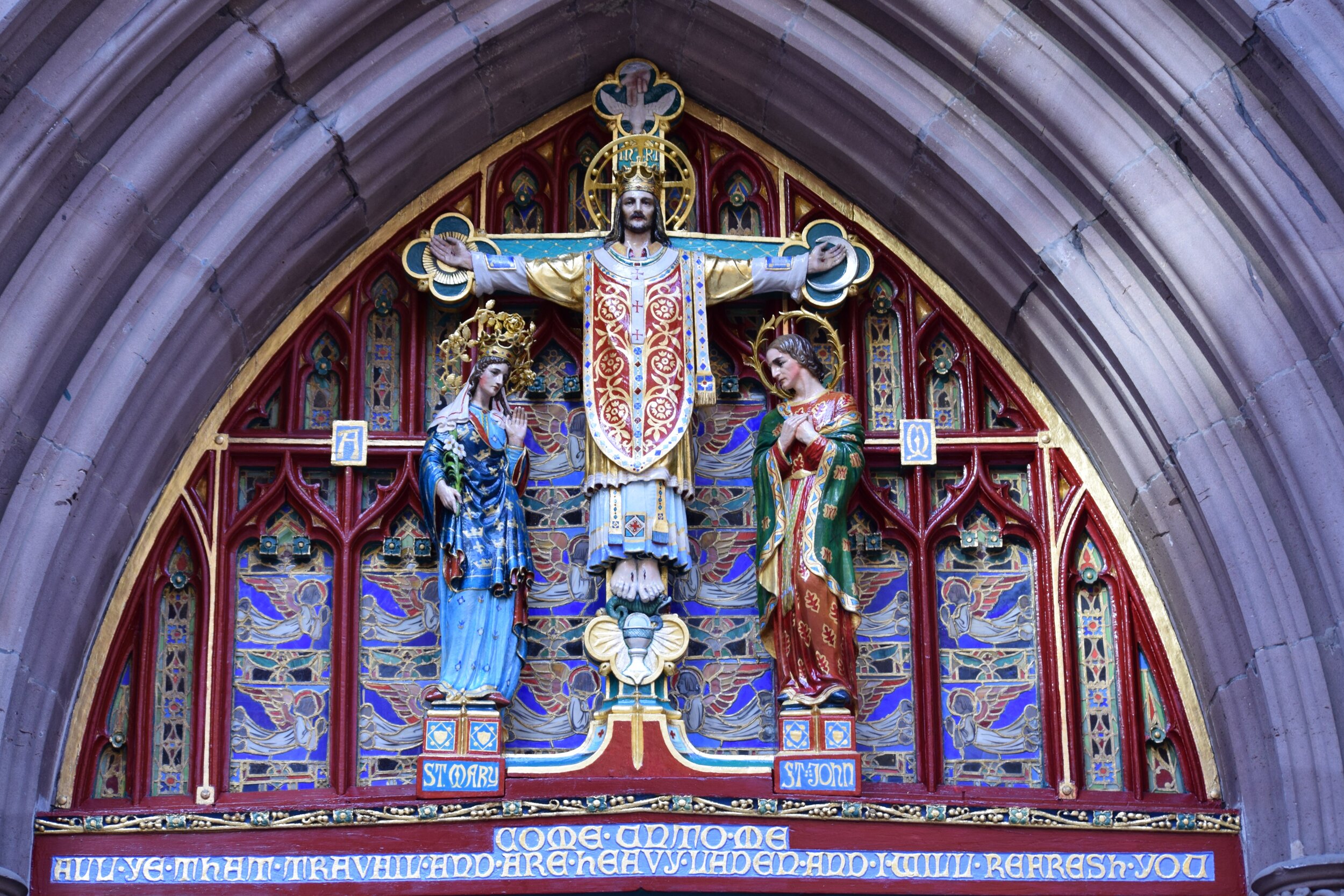
Fiske Doors Restored.JPG
Posted on February 28, 2021 .

Lent-ly

It is possible to read the story of Noah, his ark, the animals two-by-two, and the flood as a narrative that springs entirely from a question (posed, I’d assume, by a child to her parent), “Papa, where do rainbows come from?”  I am partial to this way of reading the story.

Remember what it was that prompted God to flood the whole earth in order to destroy it.  “The Lord saw that the wickedness of humankind was great in the earth.”  And God said to Noah, “‘I have determined to make an end of all flesh, for the earth is filled with violence because of them; now I am going to destroy them along with the earth.’”

You could say that, in a sense, God is exercising justice here.  His creation has become corrupt, (it was always an option) and God’s judgment is to scrap it all (or nearly all of it) and start over.  As I say, you could call that God’s justice, and for the purposes of this sermon, I will do just that.  Justice, in this sense, is whenever God acts in ways that seem to us to render judgment on our individual or corporate actions.

If God is good, and righteous, and holy, and just; then God’s way is good, and righteous, and holy, and just; and any departure from God’s way is not.  Seeing that humankind had diverged from God’s intentions, God determined that, what was his to create was also his to destroy - and to try again.

The story of the flood, and Noah’s deliverance, does show us a particularly hard-edged image of the God of love - an image that is redeemed in the narrative by the sign of the rainbow.  Because, who doesn’t love a rainbow?  And if God can give us rainbows, who cares about all that rain, right?

The rainbow is a reminder that God’s justice is tempered by God’s mercy.

I could end the sermon right here, and hope for the best, with the gentle assurance that God’s judgment is tempered by God’s mercy.  And I might have done that, had it not been for The New Yorker magazine, which last week included a cartoon in its pages that has gotten under my skin.*

The cartoon shows a man being made to “walk the plank.”   He is at the far end of the board that juts out from the gunwale of a ship.  The captain (who might be a pirate: he does have an eyepatch) has one foot on the plank and holds a sword in his right hand, and his right arm is extended in order to force the advance of the condemned toward the open sea.  Comically, the man on the business-end of the plank is wearing around his waist an inflatable floatation device of the type that young children use in the backyard pool.  This one looks like a smiling, friendly, polka-dotted sea monster.

So, there is the man, approaching the end of the plank (and the end of his life), about to plunge into the vast and dangerous sea, with a pool floatie around his waist.  Two pirate/sailors are looking on, and in the caption, one pirate/sailor observes to the other, “The captain tempers justice with mercy.”

So exactly does this caption correspond to a common assertion of Christian thought, and so clearly hopeless is the plight of the man on the plank, that I couldn’t laugh.  In fact, I nearly wept.  So perfectly does this dubious assurance match assurances that I myself have made to those in dire straits, at moments of great distress and peril, that it sent a shiver down my spine.  I am absolutely certain that more than once I have proffered this exact advice to someone who must have felt as thought they were walking to the end of a plank with nothing but an inflatable, smiling sea monster to help them survive in a sea of treachery and misery that promises only doom.

This counsel comes to hand because we so often assume that circumstances befall us as matters of God’s justice.  This idea is most succinctly express in the idea that God is punishing you because _____. (Fill in the blank.).  To which, the parish priest may counter: Of course, you know, God tempers his justice with mercy.  (I can hear myself say it!)  And, also, what a lovely rainbow!

Here we are in Lent, when we are asked to think about our accountability to God for the things we have done which we ought not to have done, as well as for those things we have left undone which we ought to have done.  Such a reflection might very well put us in mind of God’s judgment, God’s justiceIt spurs us to ask what reason God might have to be punishing us.  And if it does, we are in danger of spending these forty days merely reassuring ourselves that God tempers his justice with mercy.  And I suppose that I have often been prepared to allow myself precisely such a Lenten reflection.

But, I must confess to you that I now see that this tepid assurance of mercy in the face of harsh reality is not the Gospel of Jesus Christ.  This is a platitude.  It’s not a lie; it’s just not the real truth, or the whole truth.  It’s a platitude that we tell ourselves and others when we have nothing else helpful to say, but at least we can say this, which may not be un-true.

In fact, however, Jesus does have something to say to us, as we embark on the forty-day journey, in which judgment is always just outside our door.  Jesus spent the same amount of time in the wilderness as Noah spent battened down under the hatches of the ark, with the rain beating down on him.  All Noah got at the end of forty days was a rainbow.  (Well, in fairness, he also got to return to dry ground.)  But Jesus comes out of the wilderness with significantly more than a rainbow, significantly more than a sign of God’s mercy, having been temped by Satan.  After all, there are no rainbows in the desert.

And Jesus has something more than a rainbow.  He does not come out and tell people that forty days with the devil was tough, but that God’s judgment was tempered by God’s mercy.  No, St. Mark tells us that Jesus came out of the wilderness with a proclamation of good news.  And this is what he said: “The time is fulfilled, and the kingdom of God has come near; repent, and believe in the good news.”  

The kingdom of God has come near.

Most of us would settle for a rainbow, since our expectations of God tend to be extremely low these days.  But that would be a little like settling for a smiling, polka-dotted sea monster floatie, in the face of almost certain doom, when you are about to be drowned in the sea and/or eaten by sharks.

So, Jesus comes out of the wilderness, and he has a gospel to proclaim: that God’s kingdom has come near, and that reconciliation (which means forgiveness and love, available on the outskirts of God’s kingdom) - reconciliation is at hand as the kingdom draws near.  

Jesus doesn’t tell us that God gave him a sign that this old world is not in trouble; that God put a rainbow in the skies above the wilderness as a reminder that, bad as things are, at least the destruction of all creation is not just around the corner.  Jesus tells us that God is already making a new kingdom: a whole new universe, in which God’s goodness, righteousness, holiness, and justice are the way of life.  And that God does not need to or want to destroy us first, in order to make this new universe.  In fact, God is making it for us!

Yes, God has seen our wickedness, and how the earth is filled with violence because of us.  And so, God has decided not to destroy everything, including us; but to establish a new kingdom, a new world order, a whole new universe, for all we know.  And through Jesus, with Jesus, by Jesus, and in Jesus, that kingdom comes near, without a single drop of rain, without any threat at all of destruction, and without the need to declare that God’s justice is tempered by God’s mercy.  

(Even if, in fact, it’s true that God’s justice is tempered by mercy; if you’re not forced to walk the plank, you don’t really have to worry about it, you know!)

One literal meaning of the word Lent is “slow.”  And while we generally take from that word an invitation for us to slow down, it’s also possible to hear in the word a reminder of how slowly God sometimes moves.  It has often been painful for us to see how slowly God moves to accomplish his purposes.  And it can be deeply frustrating to see how slowly God seems to be moving to establish his kingdom.  Continental drift seems swift by comparison.  It’s difficult for us to see that when Jesus said that the kingdom of God has come near, he must have been talking in the time-space frame-of-reference of God, in which nearness and soon-ness seem not-so-near to us and not-so-soon to us.  Even in the scriptural record, it’s not until the very last book of the Bible, which foretells of things that remain, perhaps, in the far-distant future, that we hear the Son of God declare, “Behold, I make all things new.”  Until then, we have Lent; we move slowly; since, by our reckoning, God moves slowly too.

Because we know that this slow pace makes it difficult to see what God is doing, it is the ministry of the church to tear open seams in the thin places of the fabric of this world so that we can catch glimpses of the nearness of the kingdom of God.  We do this with things of beauty and acts of beauty.  We do it with works of kindness and love - what once was called charity.  We do it in prayer and reflection.  We do it in the serious study of scripture.  We do it when we seek reconciliation with God and with our neighbors.  We do it when we determine that our steps will be a pilgrimage, because we know that God has someplace for us to go.  We do it when we reach out to one another with true, neighborly affection and care.  

And most especially, we do it whenever we follow Jesus’ command to “Do this in remembrance of me,” sharing his Body and his Blood (which is to say, sharing his Love), when the heavens are torn apart and the Spirit descends on us all, with the reminder that this is God’s beloved Son, right here, with us; and we are fed in preparation for that kingdom where all is light and all is love.  All these are open seams in the fabric that separates this world from the slow-moving nearness of the kingdom of God.

It is jarring to think that it was Lent, a year ago, when this pandemic forced us all to take shelter.  It’s almost like we’ve had to batten down the hatches of our own little arks, our own little bubbles: sheltering, not from forty days of rain, but from nearly a year of airborne droplets.  What did we do to deserve this? we might ask.

Oh, don’t you know that God’s justice is tempered by God’s mercy? could come the response.  As if a rainbow would do us any good, in the midst of all our troubles.  (Well, it might make us feel better for a moment or two.)

I might have settled for a rainbow.  But God is establishing his kingdom instead.  And he means to make all things new - everything, including you and me, and all that we have lost, and all that we will lose - not by destruction, but by transformation.

Oh, how hard it is for us to move Lent-ly: to move so slowly.  But when we do, perhaps we can peek out through the tear in the heavens, at an hour like this, and see that the time is fulfilled, and the kingdom of heaven has come near.  And then, slowly, (Lent-ly), we can repent and believe in the good news.

Preached by Fr. Sean Mullen
21 February 2021
Saint Mark’s, Locust Street, Philadelphia

* the cartoon is by David Sipress and appeared in the Feb 15 & 22 2021 issue of The New Yorker.  https://www.newyorker.com/cartoon/a24537

“The captain tempers justice with mercy.”  Cartoon by David Sipress from The New Yorker, Feb 15 & 22, 2021

“The captain tempers justice with mercy.”

Cartoon by David Sipress from The New Yorker, Feb 15 & 22, 2021

Posted on February 21, 2021 .

Paradox

Not long ago I asked you to consider irony.  Tonight, I want to ask you to consider paradox.

Interestingly, a paradox can either be described as sound reasoning that leads to illogical or contradictory conclusion; or a paradox can be described as self-contradictory reasoning that leads to a well-founded or true conclusion.  It’s a paradox that a paradox can be described paradoxically as a paradox.  What fun!

Christian Faith is full of paradox: if you want to find your life you must lose it; those who lose their lives for Christ’s sake will find them.  This is the classic Christian paradox.  There are others.

Ash Wednesday is really a paradox, hidden a little beneath ashes.  For, the most solemn and distinctive declaration of the day “Remember that you are dust and to dust you shall return” is something that we believe to be true, but it is not at all what we want you to subscribe to as a matter of belief.  In fact, the most important thing you can do with the ashes that are sprinkled on your head tonight is to get rid of them, and try to forget that I ever put them there.

For all intents and purposes, Ash Wednesday looks like our own collective memento  mori: the ritualized Christian reminder that you die.  But, of course, the last thing I would want you to take away from our observances tonight is the reminder that we all die.  For, every single gathering of Christians is an opportunity for us to whisper or shout into one another’s ears another reminder altogether: memento vivere: remember that you live!  It’s a paradox.

Saint Paul was entirely comfortable with paradox, having been a persecutor of the church who became its great apostle.  Saint Paul was no idiot.  He knew that the call of Christ had entangled him in paradoxes galore.  He prayed for strength and relief, and Jesus told him: “I hear your prayer, but my grace is sufficient for you; and my power is made perfect in weakness.”  That’s paradox.  And it cannot have been easy for St. Paul to accept.  But he did.  And then he changed the world, in Christ’s Name.

St. Paul also knew what paradox looks like to smart people who have their lives and the world figured out.  It looks stupid.  It looks like you are making stuff up as you go along.  It looks like… don’t you understand that we can see how your faith doesn’t make any sense!?!  Don’t you see, how even if we accepted the terms of your argument as somehow logical, they would still lead to an illogical, absurd and contradictory conclusion: that when you die, then you go on to a new life.  Paradox, St. Paul, it’s paradox!  Oh, St. Paul might say in response, paradoxically, I see it as a self-contradictory proposition that nevertheless leads to the truth!  So, yes, it’s a paradox!

Writing to the Corinthians, St. Paul pointed out a few other paradoxes that ring with authenticity and hope, if you ask me.  “We are treated as imposters, and yet are true;” he wrote, “as unknown, and yet are well known; as dying, and see-- we are alive; as punished, and yet not killed; as sorrowful, yet always rejoicing; as poor, yet making many rich; as having nothing, and yet possessing everything.”

Paradox!  It seems like it should be a song from Fiddler on the Roof, but it comes from the wrong end of the Bible.  It’s a song that would be sung as the faithful, who are supposed by their neighbors to be imposters, unknown, dying, punished, poor, and empty-handed, are actually shown (in a feat of marvelous choreography) to be true, well-known, alive, un-punished, rejoicing, enriching, and in possession of everything that matters.

If it seems to you that what you are about to receive is a pinch of ashes on your head, I beseech you to look more deeply at the symbol.  What you are really about to receive is a pinch of paradox.  (You can see that I am working out the lyrics of the song for the musical already.) Remember that you are dust, and to dust you shall return.  Because when you remember that you are dust, you may also call to mind whose breath it was that gave life to that dust.  You may remember that you were made for paradise - that was God’s choice for you.  You may remember that, like me, you inherited the estate of self-centeredness, self-obsession, self-serving, and self-enmity from our first ancestors, who might have kept their desires fixed on God, but who always had the option not to.  (It’s like there was a paradox, right there in paradise.)

Memento mori.  Remember that you are dust and to dust you shall return.  But don’t remember it too well.  It’s a paradox.  Memento vivere. Remember that you are dust and that you will die, so that you will never forget that you carry God’s breath in you, and that you will live!  It’s a paradox.  It’s two pieces of apparently contradictory information that turn out to lead to a conclusion that’s marvelously, beautifully, deliciously, paradoxically true!


Preached by Fr. Sean Mullen
Ash Wednesday 2021
Saint Mark’s, Locust Street, Philadelphia

ashwednesday-min-e1607636606247.png
Posted on February 17, 2021 .