Climbers

Peter and James and John must feel that they are being selected for some privilege when Jesus takes them up the mountain to pray.  Climbing a mountain is an image of spiritual intensification throughout the scriptures.  Moses speaks to God on Mt. Sinai, Elijah battles the prophets of Baal on Mt. Carmel.  From Mt. Ararat, Noah glimpses the rainbow that symbolizes God’s covenant with Israel after the flood.  On Mount Moriah Abraham learns that God will not require him to sacrifice Isaac. Mt. Zion, a hill in Jerusalem, is variously taken for the mount on which the Temple is built, the whole City of David, and the dwelling place of the LORD himself.  I almost picture Peter reminding himself of these holy places as they climb.  Maybe he is excited

But maybe we, and maybe Peter, have some wrong ideas about what it means to climb with Jesus.

Maybe it’s because we lost the wonderful actor Christopher Plummer this week, but I can’t stop thinking about that scene in The Sound of Music where Maria goes to visit her mother superior and mother superior breaks into song: “Climb every mountain / Ford every stream. / Follow every rainbow / ‘Til you find your dream.”  For us, for modern folks like us who may or may not have been fascinated by that movie when we were children, the effort of climbing is important.  The story of climbing is important.  Getting to the top is wonderful, partly because it’s an accomplishment, because you “find your dream” awaiting you there: Christopher Plummer, and eventually an escape from the Nazis.  The emphasis is on personal effort and the fulfillment of personal dreams.  Not coincidentally, that effort takes Maria right out of the convent and into the world of secular romance.  That might be a clue for us that the story of personal effort and personal success is not the church’s story.  It’s Hollywood’s.   

So what’s different here?

For one thing it’s notable that this gospel story says nothing at all about the climb itself.  I know the hills around Jerusalem are not the same as the Alps, but it’s striking that what’s arduous about this experience is not the effort the disciples have to put in to get up to that holy place.  Jesus just takes them there.  

And then it has to be admitted that their experience on that mountain is nothing like an experience of personal fulfilment.    

No, when Peter and the other disciples arrive on that mountaintop with Jesus they suffer a strange disorientation. Yes, they’ve been granted a privileged vision of Jesus, gleaming like the sun and deep in conversation with Moses and Elijah, those other mountain climbers.  But if they thought it was going to be gratifying to get to the top of that mountain, if they thought it was going to be rewarding, they must have been surprised about what happened.  Because whatever else takes place for Peter and James and John that day on the mountain, I think it’s hard to say that they experience anything like a sense of achievement.  It doesn’t really resemble what we now commonly call a mountaintop experience.

Honestly, it’s when they get up there with Jesus that things get uncomfortable.  Because when they get where they are going with Jesus, they find that they are out of place.  Jesus fits right in, but the disciples are out of place.  Jesus comes into his own, but the disciples stand out like a sore thumb.  They are awkward.  Peter tries to say or do something to normalize the situation. Peter has the silly idea to build three tents.  “Rabbi,” he says, “it is good for us to be here.  Let us make three dwellings, one for you, one for Moses, and one for Elijah.”  Now, notice the complete failure of anyone in the story to respond to his enthusiastic suggestion.  Jesus doesn’t correct him gently.  Jesus doesn’t say “Peter, Peter, you worry about many things but only one thing is important.”  James and John don’t scold him or compete with him or fault him for having some big idea. Nobody says a word.  His lack of understanding just hangs there in the mountain air.  Moses and Elijah need tents why exactly?  Who would propose such a thing?  Nobody even wants to know more about why Peter is so off base.  The narration simply apologizes for Peter’s faux pas: “He did not know what to say, for they were terrified.”  

It’s not just that the disciples don’t know what to say or do, though.  They are also getting some mysterious instructions.  They hear the voice of God speaking from a cloud and saying “This is my beloved Son; listen to him.”  Isn’t it perplexing that at the moment God tells them to listen to Jesus, Jesus is deep in conversation with other people.  They can’t listen to him.  He is having a mysterious exchange with Moses and Elijah that is not for their ears.  

They’ve been taken up that mountain to see Jesus revealed as he truly is, but Mark tells us that they are also surrounded by mist, their eyesight dimmed.  What kind of revelation is that? They have been taken up the mountain and told to listen but they cannot hear.  Peter speaks but what he says is worse than nothing.  I’m certain that they are not, as Mother Superior would say, “finding their dream.”

No, if we are going to cherish and learn from this story it will not be because of a rousing message about personal accomplishment.  And for that, I thank God.

Because we have been given so much more than a dream here.  We are hearing something so much more important than a story of victory.

It turns out that it’s just possible, in the logic of our story this morning, that our darkest moments are the ones in which we are closest to God.  It may be that when we have nothing much to say—oh how hard that is for a preacher to contemplate!—when words fail us, that we are beginning to see who Jesus is.  It may be that when we know we can’t hear Jesus speak, we are hearing him correctly.  Possibly, when we don’t know what to do, we are very close to knowing who our savior is.  

We might look back at some of those other mountaintop experiences in the scriptures.  We might remember Moses coming down from the mountain to discover his people worshipping a golden calf.  We might remember that Abraham’s revelation about sacrificing Isaac is one of the most perplexing revelations in the whole bible.  We might notice that the story of Noah is a story of loss and destruction, not so much a story about finding a rainbow. 

There are hills and mountains to climb in our walk with Jesus.  We are climbing one right now, in this pandemic, in this time of turbulence and loss.  We may not be sure what it is that we are seeing.  We may not know exactly what to say or do.  All of our best efforts may hang in the air, their likely futility made manifest.  Discomfort?  Yes, discomfort at best.  Terror?  Yes, for some much more than for others.  Our vision is limited, our hearing inadequate.  

And Jesus is lord of precisely this.  Jesus is revealed in precisely this.  God is present in human suffering, not so much in the act of escaping.   Our great revelation will be made plain for us soon, as we enter into the season of Lent and make our way to the Mount of Olives with Jesus where he is crucified.   We will see him, perhaps as we have not seen him before, clothed in his full glory, taking our suffering and sin upon himself.  We will see him for who he is, in his mercy.

Preached by Mother Nora Johnson
February 14, 2021
Saint Mark’s Church, Philadelphia

Posted on February 15, 2021 .

Mothers-In-Law

There’s a scene in Episode 6 of the current season of The Crown that I can’t get out of my head.  The Crown, being required viewing for Episcopalians, I am going to assume that you have watched it by now.  If not, you probably know the backstory anyway.

The marriage of the Prince and Princess of Wales is falling apart, and Princess Diana herself is struggling mightily.  She finds herself unable to please her husband.  She is caught in the awful binge-purge cycle of bulimia, which is taking its toll on her.  All her self-doubt, and fear, and self-esteem issues, and anxiety are manifested as she wretches over the toilet bowl.  She feels constantly bad about herself, and she’s desperate for affirmation, which is nearly impossible for her to find in the royal household.  While the series takes much license, and must have invented a great many lines of dialogue, we already know that the contours of this particular part of the story are true, don’t we?

Diana goes to the Queen to seek help, comfort, and support in a time of great distress.  What she gets in return is something less than what she went looking for.  There they are in one of the grand rooms of Buckingham Palace, where Diana bares her soul.  But before long, the Queen rings a little bell, and rises to bring their session to an end.  Diana, in despair, still hopes to get from the Queen something that she needs.

“Don’t dismiss me, please,” she pleads.  “Don’t push me away.”

From the Queen, there erupts a little response, “What?” she mutters.

And before the Queen knows what is happening, Diana closes in, opens her arms, and wraps them around the Queen’s shoulders, pulling the monarch into her embrace, as the young princess tries to establish this relationship on the level she needs, calling the Queen “Maman” as she embraces her mother-in-law, and tries to draw her close.

The camera shows us the view over the shoulder of the footman who entered at the sound of the bell.  With Diana’s back to us, we can see the Queen extend her open hands out stiffly from her sides, without actually raising them.  The gesture, which resembles a shrug more than anything, never gets close to being a hug, since her arms never manage to move toward Diana.  The whole thing is profoundly awkward for the Queen, who clearly does not know what to do.  The footman looks away.  The hug lasts fifteen long seconds.

“That’s all I want,” says Diana, as she lets go of the Queen.  “That’s all any of us want from you.  Is it too much to ask?”

As I say, who knows if anything like this encounter ever took place, and if it did, if it was really anything like the way it’s depicted on the screen?

What struck me, is that the made for TV version of this story has the precise effect of confirming something unflattering about a person whom we want very much to like and admire (that is, the Queen), but which we strongly suspect to be true, even though we don’t want it to be.  In fact, we have managed to like and admire the Queen through all of the previous three seasons of the Crown, and even through much of the fourth season - although cracks have been developing by time we reach this audience with Diana.

And I strongly suspect that the way we begin to feel about the Queen by this time in Season Four of The Crown (which is to say that we are starting to feel ambivalent about our heroine), is also the way many, many people feel about God, and perhaps for the same reasons.

You are all powerful, O God; you rule the heavens and the earth; you even rule the Queen; you can do anything.  But time and time again we come to you in despair; we pour out our souls to you; you know all our secrets, and all our needs; we implore you to help us; and we fling our arms around you, wishing to be held in your grasp, in such a way that we could feel your arms hold us too, so we could know that you love us as much as we want to be loved by you.  If we could just feel you there, knowing that you hold us tight, that you hear us when we call you, “Abba, Father, Papa.”   This is all we want from you; it’s all we need.  If we could get this from you, then we could get on with almost everything else; then we would know that we will be OK, because we would know that you are there for us when we fear that no one else and nothing else is there for us... then we would find a way to muddle through.  Don’t dismiss us, please, O God!  Don’t push us away.  Just take your arms and wrap them around us, and pull as us close and as tight to you as we try to pull you close and tight to us….  But if we feel anything at all, it feels more like a shrug than a hug, as God refuses to give us what we want, what we think we need.

Anyone who’s ever prayed to God for help in lonely desperation knows what this encounter between Princess Diana and the Queen feels like - from Diana’s point of view.  And it is close to unbearable.  Is it really too much to ask?  And does it confirm something unflattering about God, whom we want so much to love - that God is distant, cold, uninvolved, or doesn’t exist at all - things we fear might be true, even though we don’t want them to be, but which become hard to refute at those times when we need God most?

The Gospel reading today gives us a different mother-in-law.  It’s early in Jesus’ ministry and in his friendship with his disciples.  He arrives at Peter’s house and is told that Peter’s mother-in-law is in bed with a fever.  St. Mark reports what happens next with efficient clarity: “He came and took her by the hand and lifted her up.  Then the fever left her, and she began to serve them.”  He took her by the hand and lifter her up: then the fever left her.

Now, I don’t know anything about the Queen, but I know what it’s like to turn to God for help in lonely desperation.  At such times, I don’t need everything to be fixed magically, but if I could only have a kind of hug that brought with it the assurance that God is with me, his arms around me, then I could muddle through.  Is that too much to ask?

I know what it’s like to turn to God feeling that I am unable to please him or anyone I care about, or even myself, and to find myself in a fever of self-doubt, and fear, and anxiety.  I know how, in the moment, it can feel like my prayer is met with stiff and absent refusal, more of a shrug than a hug, if anything at all.

But I also know something else.  I know what it feels like to discover, as I look for strength, that as I walk away from my prayer to God, I find that I am taken by the hand and lifted up, and the fever leaves me.  It does not happen in the way I wanted it to happen.  There is no drama at all, and never the kind of physical reassurance that I thought I needed and that I know I wanted.  But, without fail, the fever of crisis leaves me.

Mind you, in my case the fever is almost always self-induced, since, like most people, I am my own worst enemy.  Whether born of pride, envy, gluttony, wrath, sloth greed, or lust (and, yes, I’m familiar with them all, aren’t you?).  But of course for some of you, your worst enemy is actually cancer (your own or someone else’s), or dementia (your own or someone else’s), or depression (same), or abuse (just to name a few possibilities).   But I think, (I hope, I pray) the same thing holds true no matter what the enemy is: Jesus comes to us, takes us by the hand and lifts us up, and the fever of sickness, anxiety, failure, and hopelessness leaves us, even though we thought that we would be caught in its grip for ever.

How do I know this?  I know it, not because everything is magically made better, but because I find myself, having been temporarily incapacitated, able to serve again, just like Peter’s mother-in-law.

This is what I think happens:  

It’s as though, having been confronted by Diana, who comes to her with all her need and failure, and fear, and flings herself desperately at the Queen.  The monarch, who is not the type to solve things with a hug, instead instructs the footman to leave the room and close the door behind him.

The Queen steps back from the pleading princess, who slumps back into her chair, and the Queen looks down at her with a strong but not unkind face.  The Queen draws a slow, deep breath, she sees that this child’s life is out of control and in real danger, and so now, she approaches.

The Queen will not speak: it is not her way.  The Queen will not hug: it is not her way.  But a look of mercy and pity crosses her face as she bends toward the crying princess and extends her royal hand.  She lifts Diana’s chin, so that she can look into her tear-filled eyes.  Then she reaches out that powerful hand and takes the princess’s hand in hers, and lifts her up, without so much as a word.  And in the act of being lifted, the princess can feel strength flowing from the hand of the monarch into her own hand, down along her arm, through her chest, and into her tortured belly, down through her hips and into her legs and feet so that she finds herself standing, and doesn’t even know how.

The Queen has taken her only by the fingertips.  She has not hauled the girl up by brute force, she has lifted her - the princess can see this now - by grace, and by a power that is familiar with weakness, and that knows how to handle a wounded soul with care.  The whole thing might take no more than fifteen seconds, but when it has happened, Diana realizes that she has not been dismissed (as she feared she would be), she has not been pushed away.  The Queen has come to her and lifted her up, and the fever has left her.  And she is able to get up and go on serving, which she was always willing to do anyway.

Except that the Queen is Jesus; and the princess is me, or you, if you want it to be, if you need it to be.  And it’s not a scene in a Netflix series; it’s the experience of throwing yourself on God’s mercy, and needing God to do something about the fever.

No one ever says that their favorite person in the Bible is Peter’s mother-in-law.  No one ever aspires to be like her.  But she’s exactly who we all want to be like, at some stage of our lives: the person to whom Jesus comes and takes by the hand and lifts up from despair and hopelessness.  And it’s not magic, which is what we were kind of hoping for, even though we don’t believe in it.  Rather, it’s faith that’s born of love, which is the only power that can bring true strength in the midst of real weakness.

And, no, it’s not too much to ask for.  It’s precisely what Jesus came to do.

Preached by Fr. Sean Mullen
7 February, 2021
Saint Mark’s, Locust Street, Philadelphia

Olivia Colman as the Queen

Olivia Colman as the Queen

Posted on February 7, 2021 .

Vaccination

Although today is the Feast of the Presentation, it’s vaccination that’s on everyone’s minds.  Have you gotten yours yet?  Both shots?  Or just the first?  Are you in a prioritized category?  Have you signed up yet online, and will that make any difference?  Have you started making plans for life after vaccination?  Like, travel plans?  How long do we have to wait before we can do that?  If only we could celebrate the Vaccination of Jesus, rather than the Presentation of Jesus!  Somehow that might make us all feel better!

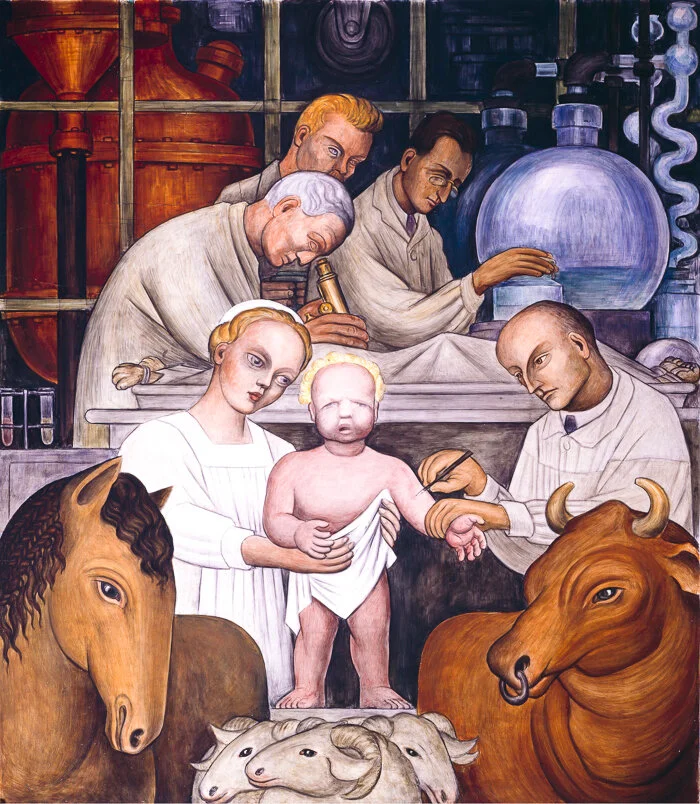
Recently a friend shared with me images of the murals by the Mexican artist Diego Rivera in the Detroit Institute of Arts, which I had never seen before.  I had certainly never laid eyes on the most controversial image of the twenty-seven panels of this incredible installation of 20th century art: the panel which is known as “Vaccination.”

To any and all, the painting looks like a modern version of a Nativity scene, presented in the curvy but boxy, crayon-colored style of Rivera.  In the center, a golden haired child, painted with that odd combination of blockiness and roundness.  On one side, a nurse (his mother?) holds the child in swaddling clothes.  On the other side, a doctor (Joseph?) firmly holds the child’s left arm while carefully sticking a needle into fleshy, baby biceps.  In the background are three men; let’s assume they are wise men.  They are scientists, dressed in lab coats, and hunched over a microscope.  In the foreground are animals: a horse or donkey, an ox or cow, and three sheep or rams.

As an image for our times, when anti-vaxxers have been confronted by the real and necessary promise of vaccines that do more than just save lives (they also restore a crippled society), this marvelous painting by Diego Rivera, with all its religious overtones, is stunning.

When it was completed in 1933 (during the depths of the Great Depression), the whole monumental work in the Garden Court of the DIA caused a great stir.  But this one panel - Vaccination - was the subject of the most pointed and urgent criticism.  Various Roman Catholic groups took aim at its composition and imagery.  And The Detroit News reported that “the Rev. H. Ralph Higgins, senior curate of St. Paul’s [Episcopal] Cathedral… objects particularly to the so-called vaccination panel… ‘The painting should be washed from the walls, because it inevitably must impress the spectator as a satire of that family dear to religion,’ Mr. Higgins said.”*

On the Sunday after the murals were first open for public viewing, in March, 1933, more than 10,000 people went to see them.  I’m guessing that’s significantly more people than went to hear Mr. Higgins preach that Sunday.

Now, Diego Rivera was a notorious atheist (and, worse, a socialist!). He called religion “a form of collective neurosis;” one of his famous murals includes an inscription that reads “Dios no existe;”** and he once quipped that “I’ve never believed in God, but I believe in Picasso,” firmly establishing his atheist credentials.  In fact, though, according to the New York Times, Rivera “denied that the panel, ‘Vaccination’ was intended to caricature the Holy Family.  On the contrary, he said, he had rather tried to sanctify science as contributing to the saving of life.”***

But the story of this particular mural gets even better.  Good authority has it that the face of the baby was modeled on the Lindburgh baby, the news of whose kidnap and murder had been in all the papers while the murals were bing made.  Dig a little deeper, and you’ll find, also on good authority,**** that the face of the nurse/mother/Mary was inspired by Jean Harlow; the doctor/father/Joseph was modeled on the museum’s director; and that the three scientists/wise men (each with distinctive flesh tone and hair color) are supposed to be a Catholic, a Protestant, and a Jew.  Boringly, the animals, which to me surely look like references to the stable-residents in Bethlehem, are said to represent creatures from whom was supplied serum for the production of vaccines.

Rivera’s atheism is said to have stemmed from his objection to the vicious effect of the Roman Catholic Church on the indigenous peoples and cultures of Mexico, when the church came, arm in arm with the conquistadors; and also from his reflection on the explanation given to him when he was five years old, as to why his twin brother had died at the age of two: the explanation being something along the lines of “God needed another angel.” 

I suppose that Rivera could not have foreseen a progressive church for which the image of the vaccination of the baby Jesus could represent a beautiful confluence of the life saving work of Science and Savior, without any need to insist that their spheres of interest, inquiry, and influence are separate from one another.

In the Epistle reading from Hebrews assigned for today, the writer says, “Since God's children share flesh and blood, Jesus himself likewise shared the same things, so that through death he might destroy the one who has the power of death….”  This notion, that God became like us - flesh and blood, and all - through the sending of his Son, in order to save us, undergirds a great deal of Christian theology.  It’s trying to make sense of why God acted in this way; why God chose to express his love in this way; why God used the soft power of the Incarnation, rather than deploy armies from heaven to save us from the power of death and the devil.

Diego Rivera may not have believed any of that, but in some way he clearly understood it.  And his Vaccination mural is a stunning depiction of the Incarnation, whether he wanted it to be or not.  The juxtaposition of the incarnate Savior, endowed with the face of a kidnapped and murdered child, receiving the gift of vaccination, is what you might call inspired.

You can almost imagine an elderly couple, down on their luck in 1933, both unemployed and hungry, and maybe out of hope, going to the Detroit Institute or the Arts on a Sunday morning in March, since they had nothing else to do, and a couple like that was not very liken to darken the door of the Rev. Mr. Higgins’s cathedral.

I can see them standing in the Garden Court and taking in the color and the rhythm, and the action, and the figures of Rivera’s immense and detailed murals, with their heads bent back, and their necks craning, as they take in the murals of Detroit Industry.  The couple is old and tired and poor.  If ever they had imagined that God had made any promises to them, they’d long ago concluded that God had reneged on those promises.  

And standing before the north wall, they look up to the right, in the corner, where this panel of smaller scale shows a scene at once so modern and so ancient, so weird and deeply familiar at the same time.  It’s a child (who looks disturbingly familiar to the old couple) being given a vaccine.  Are those his parents?  Or a doctor and a nurse?  And who are those three men behind them?

But doesn’t the whole thing just look like hope?  Doesn’t it look like life?  Doesn’t it look like salvation?  And aren’t there words echoing now in the hearts of these two old folks, whose lives are coming to a close in a world where there was not much hope left for them: “Lord, now lettest thou thy servant depart in peace; for mine eyes have seen thy salvation, which thou hast prepared before the face of all people.”


Preached by Fr. Sean Mullen
Feast of the Presentation of Our Lord in the Temple, 2021
Saint Mark’s, Locust Street, Philadelphia

  • * Clifford Epstein writing in the Detroit News, March 1933

  • ** “God does not exist.”

  • *** from The New York Times, March 22, 1933, “Detroit in Furor Over Rivera Art”

  • **** That authority is Linda Downs, who literally wrote the book on the Detroit Industry murals.


Vaccination by Diego Rivera, from the Detroit Industry murals at the Detroit Institute of the Arts

Vaccination by Diego Rivera, from the Detroit Industry murals at the Detroit Institute of the Arts

Posted on February 3, 2021 .