
Christ Mounting the Cross

A few years ago I climbed the scaffolding against the west end of the church.  It was only 30 feet up or so.  But I had to climb the ladder integrated into the scaffolding, and then squeeze between and under the railing to get up there.  When I arrived I was proud of my self.  Prouder still when the mason looked at me and said, “Father, I gotta give you credit, most people don’t come up here.”

I have also climbed a ladder up to nearly the top of of the inside of the tower of Saint Mark’s, maybe just 10 feet below the tippy top of the tower.

I am thinking about ladders.  Sometimes a ladder is an important symbol or image.  I think of Jacob’s ladder.  Curiously, in his dream , Jacob didn’t have to dream about growing wings to fly up to heaven.  He didn’t have to become like the angels.  He could just be himself.  All he had to dream about was a ladder.  Nothing about him had to change.  All he needed was a ladder to get to heaven.

There is a ladder implied in the Passion narrative.  Most often we imagine it as part of the Deposition of Christ’s body from the Cross.  We picture a ladder set up against the Cross so that the Roman functionaries, aided, perhaps by Joseph of Arimathea’s men, or by one or two of Jesus’ other disciples, in order to lower Jesus’ lifeless body from the Cross.

It’s one of the often depicted symbols of the Passion, along with the pincers, the spear, the sponge, the nails, the hammer.

But sometimes we find in art another version of the ladder set up against the Cross.  In these rarer instances, the ladder is used by Jesus himself in oder to ascend to the Cross.  In Christian iconography the image is referred to as Christ Mounting the Cross.

I have an image here of Jesus using a ladder to ascend to his own Crucifixion, to take his place on the Cross.  And in this image you can see some of the figures in the crowd standing by.  You can see Mary, along with some of the other women, and maybe some of the other disciples.  You can see a man standing there with a basket holding the nails to nail Jesus to the Cross.  And there is a man standing there, holding his arm up to Jesus, lifting up the hammer, to hand it to Jesus.  The image suggests that not only will Jesus climb up to the Cross himself, he will nail himself to it as well.  It’s a striking image.

Sometimes in these images, there is another person up on the crossbeam of the Cross, to assist Jesus once he gets there.  A Roman functionary, I guess.

The obvious message of an image like this is that Jesus goes willingly, voluntarily to his death.

But at a time when nearly 100,000 people around the globe have died in the past months of a pandemic, thinking about Jesus going to his death is poignant, because his death always has something to say about our death.

Jesus goes to his Cross because that’s where his work of salvation is going to be done.  On the Cross is where, by dying, Jesus is going to defeat death.  On the Cross is where Jesus is going to shed his blood, which somehow mystically becomes the lifeblood of the world.  He hangs himself there almost like blood drip hanging above a hospital bed, as though his blood is going to drip into our veins and make us better.

Jesus climbs up to his death in order to rob our deaths of their sting.  Go ahead, he says, hand me the hammer and the nails, as if to show us that he has mastered pain and misery too.

Like Jacob, Jesus doesn’t need to change anything about himself to go up his ladder to the Cross.  He goes just as he is, in all his humanity and in all his divinity.

In those images where there is a second person up on the Cross to assist Jesus when he gets to the top of the ladder, I imagine a very odd conversation taking place between the two.  I imagine that functionary up there looking at Jesus and saying to hi, “I gotta give you credit, Jesus, most people don’t come up here on their own.”

No, no one goes to death on their own.  That’s why Jesus went up his Cross to his death: a painful, shameful, and ignominious death, a deaths bad as any death.  Only Jesus has clibmed the ladder of death alone.  And because he has climbed it no one else ever has to.  Only Jesus goes to death alone.  For the rest of us, he is already there, to go with us.  And no else every has had to go alone, and no one else ever will.

Notes for a sermon preached by Fr. Sean Mullen
Good Friday, 2020
Saint Mark’s Church, Locust Street, Philadelphia
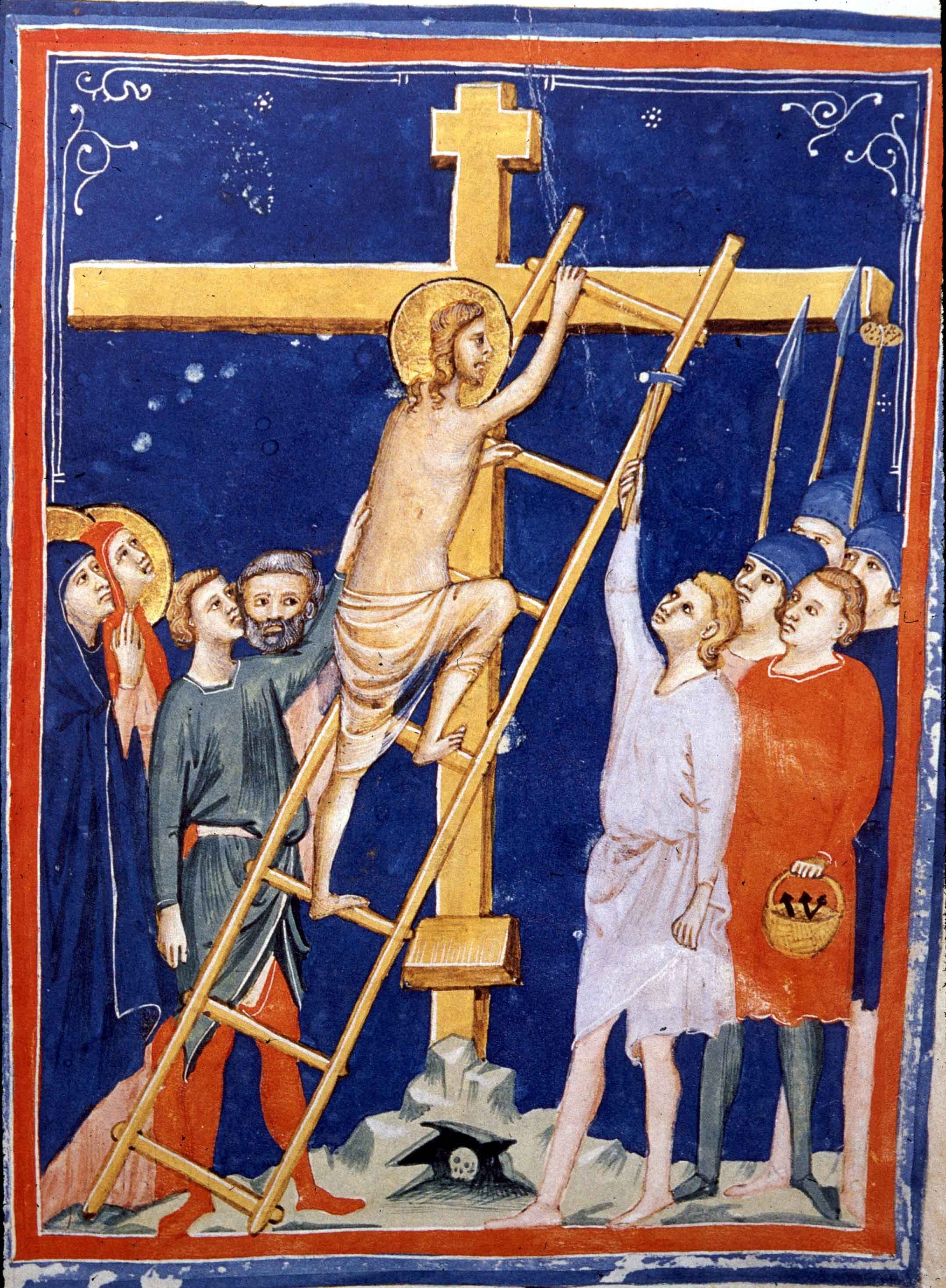
ladder-at-cross-bonaguida-small.jpg
Posted on April 11, 2020 .

The End Is at the Beginning

“Don’t spoil the ending!” That should be the mantra of any storyteller. We all know that the art of great storytelling is in the pacing, laying out just enough details to tantalize the listener, create suspense, but not reveal the decisive turning point too soon.

Don’t we all know this story, I mean the story we have just heard? Here we are, beginning Holy Week with a story that we know all too well. You know the ending. I know the ending. Even people with little to no faith or people of other faiths know the ending of this story. There’s no spoiler alert on this one. Here it is: At the height of his ministry, Jesus enters Jerusalem in triumph, with crowds cheering him on and strewing palm branches before him. Many have seen his works, and others have probably heard of them. Maybe he is indeed the long-expected king. The people’s cheers seem all the more sardonic on that day when Jesus rode into Jerusalem because we know how it all ends. The people, of course, quickly turn on Jesus, who turns out to be a different kind of king than they had imagined. Jesus is then betrayed by Judas. He is condemned unjustly. He is brutally executed as a criminal, although innocent, outside the walls of Jerusalem, denied even by his closest followers. He is stripped even of his clothes, and he gives up everything, his very life and self for the sake of those who are torturing him and for the sake of the whole world. He is buried in a tomb. And, at least for today, there the story stops.

If we didn’t know the true ending, Jesus’ gruesome death on the cross between two criminals would be seen as the climax, awful as it is, to this story. And the burial in the tomb becomes the mournful coda. But you and I know the real climax of this story, and so Jesus’ burial, as we perceive it, is something like a cliffhanger. We know the real ending, because it’s at the heart of our faith. We know that the power of the real climax changes everything in the story. But in terms of what we hear today, the climax is still in the future. And if we were hearing this story for the first time, we wouldn’t know that the crucifixion wasn’t the climax.

So why, year after year, do we return to this story of betrayal and death when we know how it ends? And even more perplexing, why do we begin this holiest of weeks in the church year with a story that we will hear again on Friday? Today, we hear of Jesus’ crucifixion, but on Thursday, we will wind back the clock and hear the story of the eve of Jesus’ death. The order is all wrong. But then, it never really is a linear story to begin with, is it? 

There is a huge risk in telling the story when we already know the ending. We risk becoming numb to the power of the story. But the real temptation is in wanting to jump right to the end, so that everything can be tied up with a bow and so we can experience the happy ending and be done with it all.

Because, truth be told, we can’t help but read the happy ending into this story as we hear it today. We are not hearing this story for the first time. The glorious real ending of this story colors and shades everything about the cross and passion. But that’s a story for later in the week and not for today. Today, we need to stay with the first part of this story.

Because here we sit in the midst of another story. It’s one of epic proportions, and it’s a story of suffering, tragedy, loss, and woe. According to all accounts, we’re only at the beginning of this story. But unlike the Gospel story, we don’t know how this story will end. And that’s why it’s so horrifying.

Truth be told, we don’t know how much longer we’ll be in self-isolation. Every day the story’s drama increases. Every day, the numbers of the sick and the dying and the dead rise. Every day, we find ourselves stepping up our measures to try to flatten the curve or stem the tsunami-like force of the tide of sickness and death that threatens to overwhelm us. We don’t know what kind of hard decisions we’ll have to make. We don’t know if there are enough ventilators and medical equipment to support the numbers of the sick. We don’t know whether, with our next breath, we might be breathing in that insidious, vicious virus. We don’t know how we will endure more months of self-isolation.

And even on the other side of sickness and death—because this story will end at some point—we don’t know what it will be like. We don’t know how many of our friends and loved ones will have been affected. We don’t know what it will be like to interact normally again and not as if we’re scared of one another. We don’t know what church will feel like afterwards. We won’t know if we’ll be able to shake any one’s hand again. We don’t know how many jobs will be left. We don’t know which of our favorite restaurants and businesses will survive. And if we become too obsessed with these open-ended questions, it all becomes too much.

So, don’t you find yourselves longing for a happy ending? Don’t you want to jump right now from Palm Sunday directly to Easter? We know that the Good News triumphs in the end, so why can’t we just have it now? 

Or is the Gospel story we tell today exactly what we need to hear in this moment? Perhaps this story, and the peculiar way in which we hear it, knowing the ending and all, can shine some light on our current crisis.

I suspect that the full force of the story we tell, the story at the heart of our faith, lies in the fact that year after year, we continue to tell it in all its gory detail even though we know that the ending is good news. We know that the ending is the definition of Life itself. We know that Love wins out in the end. We know that the Light overcomes the darkness.

But we also know that the happy ending does not wipe out all the tragedy. It doesn’t eradicate it. It doesn’t pretend it never happened. It doesn’t try to move as quickly as possible through it to some brighter future. No, it draws all of that mess into a different light and carries it forward and redeems it. And the particular beauty of this happy ending, of this good news, is that it subverts suffering and death by entering into it, surprises it, if you will. If this were the typical post-Enlightenment story that we want to hear, we would have moved inexorably towards glory and then erased all memory of the nasty parts. We would have evolved into greater selves, where the good always wipes out the bad. But our story doesn’t do that. And that’s why it’s so good.

And so this day, we preach Christ both crucified and risen, because we know how the story ends. But we sit with the overwhelming tragedy that is present in the lead-up to that happy ending. Today, with our worries about a rapidly spreading pandemic invisibly haunting the world around us, we tell our story. Today, with family members and friends shielded in our hearts by prayer, we tell our story. Today, in this empty church connected digitally to your home, without physically interacting with one another and through the impersonal means of technology, we still tell our story. And although in some sense, we don’t know what’s next, we do know something about its real ending, which is in its beginning, and its middle, and everywhere. We know, right now, that Life is the victor and Death is the loser. Even when the ending of our particular story is not fully known, the real ending of another greater story takes up our own and shines upon it. 

As we tell our story of pain and suffering in the presence of that other story from over two thousand years ago, we see the veil between this world and the next, like that veil in the temple, torn in two. And we get a glimpse into God’s kingdom breaking into this world. The happy conclusion doesn’t happen at the end of the story; it meets us time and again in the midst of it. 

If the coronavirus has taught us anything, it’s that we can only live day by day. And each day, as we wake up to tell our story, we have the gift of finding God anew. God is here with us in our story of suffering and death, and like palm branches strewn on the path before Jesus, God is strewing love and peace and healing and comfort and strength all around us. 

Because when we talk about God’s story in Christ, there is no way to spoil the ending. And when we tell that story, we are also telling our story. We know the ending, and the ending is at the beginning. And the ending is in the middle, even as today we linger for a while with suffering and death. That pain cannot be erased, but something much greater ultimately wins, indeed, is winning. And you know the end of that story, even now at the beginning.

Reflections for a sermon preached by Father Kyle Babin
Saint Mark’s Church, Philadelphia
Palm Sunday 2020

Posted on April 5, 2020 .

Love Carries The Day

Lord, he whom you love is ill. (John 11:3)

Down-playing the seriousness of the illness.  Unreasonable delay in taking steps to address the crisis.  Making unsupported claims about his own authority.  Failing to take responsibility for acting too late.  All these are features of the story of Jesus’ raising of Lazarus, which begins when Jesus gets a message from Mary and Martha that his beloved friend is sick.  “Lord, he whom you love is ill.”

And Jesus doesn’t rush to save him.

Now, let’s be clear: Jesus is not the president of the United States, and the president of the United States is no Jesus.  No sir.  Not even close.

But it is possible that the Gospel has something to say to us in the midst of our current crisis, because the Gospel knows what crises like these feel like.  Admittedly, the death of Lazarus is the tiniest microcosm of our current moment.  

But we can assume from the few details we have in John’s Gospel that Lazarus died too young and unexpectedly, and from a sudden illness.

Martha has the hardest words for Jesus: “Lord, if you had been here my brother would not have died.”  When she adds he next statement, it feels only weakly hopeful to me: “But even now I know that God will give you whatever you ask of him.”

What was she hoping for?  A passage to heaven for her brother Lazarus.  That seems to me to be the most she could have hoped for.  A word of consolation would have been enough, a promise that there is something beyond, the assurance that now he is in a better place.  

I am well familiar with such words of consolation, since I have dispensed them more than once in the face of death.  So often it feels like the best you can do.

But I am no Jesus.  No sir.  Not even close.

The raising of Lazarus provides the perfect backstory for the beginning of Jesus’ establishment of a zombie army for the coming apocalypse.  Lazaraus, the first zombie, could have been Jesus’ trusted lieutenant as they overpower the Roman occupiers and set up a religious state dedicated to the  establishment of God’s reign on earth.

But sadly, Lazarus is no zombie. No sir.  Not even close.

It’s telling that Lazarus says nothing in this story, after he has been resuscitated, and we never hear from him again in the Gospel.  Although there is a legend that says that Lazarus and his sisters were all put into a boat that had no sails, oars, or helm, and that managed to convey them all to the south of France, where Lazarus became the bishop of Marseilles.

Part of me doesn’t object at all to this legend.  Part of me wants France to grab hold of any reminder of hope, any memory of the triumph of life over death.  And what better reminder could there be than Lazarus?

And not only France, of course, also Italy, and Spain, and Germany, and New York, and Seattle, and Philadelphia, and every corner of the world that’s overtaken with worry and fear and sickness and death.  Lord, he whom you love is ill.

Because, remember Lazarus is alive, he is not a zombie.  And his resuscitation serves a singular purpose: that purpose is to demonstrate that Jesus has power over death.  And if he has power over death, then he also has power over life.

The purpose of Lazarus’s resuscitation is not to show us all what can and will happen to us.  No, it’s a wonder that Jesus didn’t say to those standing by, “Look, I’m only going to do this once,” because the fact of the matter is he was only going to do it once.  And we do well to remember that not one of us is any Lazarus.  No sir.  Not even close.

When Jesus raises Lazarus from the dead, it is to show that he does indeed have power over death, which is going to be very important if people are going to realize who he is, if they are going to be able to see him for who and what he is, if they are going to  believe that he is more than a teacher, more than a rabbi, more than a healer, more than a miracle worker.  It’s very important if they are going to invite him to have power over their lives.

It’s interesting to note that no one ever responds to Jesus’ raising of Lazarus with fear and amazement, as is the case with so many of Jesus’ other works of wonder in the Gospels.

I think part of the reason that fear and amazement are more or less missing from this story, is because there is an explanation for the miracle of Lazarus’s resuscitation provided from the very beginning of the story, when a report is first brought to Jesus about Lazarus’ condition.  “Lord,” they say to him, “he whom you love is ill.”

John is at pains to repeat that Jesus loves Martha and Mary and Lazarus - all three of them.  And then, when Jesus arrives at Bethany, to find that Lazarus is already dead, and Martha and Mary are weeping, John tells us that Jesus wept too.  And again, an explanation for what is about to happen is provided.  Those standing by already know what power is at work in him, for they say, “See how he loved him.”

Yes, sickness is at work here.  Yes, death is at work here.  Yes, there was unreasonable delay in a potential cure.  Yes, even Jesus himself downplayed the seriousness of the illness.  Yes, he made claims that could not at the time be supported about his authority to make everything well.  Yes, he fails to take responsibility for responding too late to pleas for help.

So sickness and death seem to be the ones who will carry the day.

But love is at work in him.  And love is more powerful than sickness or death.  And that is the lesson Jesus wants us to learn and to know.

Now, look, he’s only going to do this once (until his own resurrection, that is), so he wants us to see it.  Love carries the day.  Sickness and death will happen, but love will carry the day.  Love wins, as we often like to say these days.  

Lord, the one whom you love is ill.  This is not a cry from the past, it is our present crisis.  And Jesus knows.  Jesus weeps.  For Jesus loves us.  And love will carry the day. 

Notes for a sermon preached by Fr. Sean Mullen
29 March 2020
Saint Mark’s, Locust Street, Philadelphia

The raising of Lazarus by William Blake

The raising of Lazarus by William Blake

Posted on March 29, 2020 .