
The Pudding's Proof

When John heard in prison what the Messiah was doing, he found himself starting to wonder. He was, if you’ll pardon the expression, a little on the fence, even as he sat behind bars. Was this really the Messiah? How could he know? How could he see the truth if he couldn’t see the man with his own two eyes? He sat in his cell, doing a bit of mental to-ing and fro-ing until he came up with a brilliant idea. He would send his disciples to ask the man directly, Are you the one we’ve been waiting for or not? It was, if you’ll pardon the expression, a light-bulb moment. He would just get the answer straight from the horse’s mouth.

When Jesus saw John’s disciples heading towards him, the determination he saw in their faces made their purpose crystal clear. They were clearly men on a mission, looking for answers, and when they opened their mouths they immediately laid it on the line. They didn’t beat around the bush or pull any punches. Are you the one we’ve been waiting for? And so Jesus tells it to them straight. Look at me, he says. Look at all that I have done and said. Don’t you see? The proof, if you’ll pardon the expression, is in the pudding.   

But can we pause here for a moment and acknowledge that of all the idioms I just threw at you, “the proof is in the pudding” is one that makes absolutely no sense? It’s as ridiculous a phrase as “you’ve got another think coming.” The proof is in the pudding? It sounds as if you might find a revolver with Colonel Mustard’s fingerprints on it if you dig around long enough in a bowl full of Jell-O. But do a little investigative googling, and you too can discover the sense in “the proof is in the pudding.” The original idiom was first recorded in the Middle Ages, not as the proof is in the pudding but as the proof of the pudding is in the eating. Now we’re getting somewhere. Of course, it helps to know that “proof” here has the older meaning of a test or a trial, not of as a synonym for the word evidence. The proof is a test, so the testing of the pudding is in the eating. This is beginning to make sense. And it will make even more sense when we realize that the pudding in question is not a chocolatey, creamy, dessert but rather a pudding in the old-fashioned, British sense of the word – a chunky, meaty sausage, which may or may not have been cooked all the way through, which leads us back to why the proofing is so darned important. It seems to have been Americans in the 1920’s who shortened the phrase to the proof is in the pudding. Apparently the stresses of Prohibition caused the populace not only to shorten their patience with return on investments and the length of their skirts but also their idioms, sometimes beyond all comprehension.

The proof of the pudding is in the eating. In other words, you have to test the product – or the person – to see if it’s true, if it’s good for you, if it will nourish and sustain you or cause upset and dis-ease. Which is exactly what John’s disciples are up to here. They want more than just a verbal confirmation that Jesus is Messiah. They’ve heard that line before; heck, they’ve even spoken that line before. They heard John the Baptist talk about Jesus’ baptism, about the voice that spoke from the heavens, calling Jesus Beloved Son. They’ve listened to John’s words about repentance and the kingdom that is coming, and they’ve seen him cast his steely eyes upon Jesus as he did so. The kingdom is coming, they’ve heard him say, and the start of it is standing over there in those sandals, the latch of which I am unworthy to stoop down and tie up.

John’s disciples already knew what had been said about Jesus. They knew what they had heard, but now they wanted more – they wanted proofing. Had Jesus simply said to them, why, yes, I am the Messiah, please go tell John the good news, they would have gone home slightly, but not entirely, reassured. But Jesus offers them more than just a verbal confirmation. Jesus offers proof. Test me, he tells John’s disciples. Test me and then see how you feel. Look and listen, and tell John what you hear and see. The blind see. The lame walk. Lepers are cleansed, the deaf hear. People are raised from the dead, and the poor lay joyful claim to the Gospel. The proof of the Messiah is in the seeing, in the noticing of the miraculous things that that Messiah does, not just in the word that he is. A pudding can look like a pudding but still not be good for eating; if a Messiah claims the name but does nothing with it, he is as good as a pudding half-baked.

The proof of the Messiah is in the seeing, which leads me to this tricky question. What have you seen? If the disciples of John came to you and asked you this one simple question – Is Jesus the one we have been waiting for? – what would you say? If Jesus were to say to you, Go and tell all that you have seen and heard…what would all that you had seen and heard be? Would you have a story to share, of the lame leaping or the speechless singing for joy? Would you tell of a moment you felt God’s hand reach out and still your anxious heart? Would you tell of a time when you saw a relationship mended, an old wound bound up and anointed with holy balm? Would you tell of a job found, a need filled, a belly fed? Would you tell of a time that you heard No and thought that it would be the end of you, but then found that No opened up an entirely new set of Yeses in your life? Would you tell of a physical healing, a prayer answered, a broken body made whole? Would you tell of a holy death, a hopeful passing that made real for you the truth of the resurrection? What would you say?

I know what I would say – that I have known God in the touch of a stranger, that I have heard God’s answers to me in profound and unexpected and sometimes frankly hilarious ways, that I have felt God listening when I sang Kyrie eleison, that I have known God by the gifts of people brought into my life. That’s what I would say. I don’t know what you would say, but I hope you do. I hope that if someone asked you – Is Jesus the one we’ve been waiting for? – you would have the most marvelous proof for your pudding. I hope that you would say, look and see all that the Lord has done for me! Please, let me tell you of all the ways I have been wondrously and miraculously fed.

And if you don’t know what your proof would be, well then welcome to Advent. What better time than Advent to do some thinking and praying about what your pudding’s proof? What better time to ask yourself your own simple questions… like, what is it about Jesus Christ that brings you here? What is it about Jesus Christ that brings you joy? What is it about Jesus Christ that brings you comfort, or conviction, or that calls you to do something more than you ever thought possible? What is about Jesus Christ that makes this season a time of truly happy expectation?

Our world needs your answers. The broken and wounded and afraid and cynical and beat-up and above-it-all are out there, waiting to hear what you have to say, waiting to hear what you have seen and heard, waiting, whether they know it or not, for the gift you have to give them. So tell them. This is the proof in your pudding. For the proof of the Christian is in the bearing witness. They will know we are Christians by our love, ‘tis true, but not just by our love but by our love in Jesus’ name. This is how we keep the Christ in the Christian – by bearing witness to all that our Lord Jesus Christ has done for us, to the ways we have seen him be Messiah in our lives. We must be both energetically explicit and honestly humble about this. The world has had enough of Messiahs in word only, who, once tasted, are full of bitter judgment and nauseating exclusions. And the world had enough of Messiahs in word barely, who, once tasted, leave the stomach empty and grumbling for more. We have more to offer – a real witness to a real Christ, really present in this wine and this bread, really present in the people in these pews, really coming at Christmas. We have more to offer than, as one contemporary theologian puts it, “ignorance on fire or intellect on ice.”* We have real food, meat indeed, saving sustenance that delights both the heart and the belly. We have real food, and the world is starving.

So stir up your stories, you faithful. Stir up your souls and rejoice. Stir up your witness to all that you have seen and heard. Stir up your proofs of the power of our Lord Jesus Christ, the Messiah, the Savior, in this world and in the next. Stir up your pudding, and let the proof be in the eating.

*Brian McLaren, taken from his latest book The Great Spiritual Migration

Preached by Mother Erika Takacs

11 December 2016, The Third Sunday of Advent

Saint Mark's Church, Philadelphia
Posted on December 13, 2016 .

The Seventh of December

From a single point in heaven all sevenths
of December can bee seen; as if,
observing from his glass, the Lord can pinpoint
one or another, on the map of time
laid out before him in order, from left to right,
or right to left, depending; as though it matters
to him who made all time, and views it all
simultaneously.

There’s Ambrose in his cradle: a swarm of bees
alights, and buzzes round the child’s head;
a drop of honey left behind to tell
of sweetness yet to come. 

And there’s the blue
Pacific sky abuzz with aircraft pollinating
war.  The bluer ocean claims her dead,
entombs the Arizona, a tomb herself,
and marks this day with infamy.

                                                            And there
on Morningside Heights is me, amid the soaring
stone, assured that I’ll soar too when hands
are laid on me, to tell the Spirit where
to land.

          From heaven, to one and all the angels
bring their messages; the old angelic subject
line: “Fear not!”  To Ambrose’s dad, to sailors
as they drown.  When my peculiar angel
speaks, I look at him, and say, “Of course,
for what have I to fear?”  To which, replies
the angel, “Only your own foolishness,
which, on its own, may not amount to sin,
but that, of course, depends on you, you see.”

“Be dressed for action,” the angel said.  “And hear
the call of Christ to go where he directs
you.  Remember, your first pilgrimage
will be to go between the altar and
God’s people in the world.  Return again
as often as required, inscribing in your
heart the route from there to there.  When you
must speak be sure to speak of Jesus, who may
return at any time, sit down to eat.  And who
will serve the Lord?  Will you be up?  Will you
pay heed, and go, unlock the door, warm up
the basin, wash his feet?  Will you attend
his call, and still attend the call anon;
the timeless call you know,  ‘Come, labor on.’”?

Where did that angel go?  What words has he
for me, for you, all these years on?  He bids
us to the vineyard day by day.  And then
he whispers in my ear (and yours): give thanks,
give thanks.  All other gifts, it seems, will flow
from this thanksgiving theme, inscribed a bit
more deeply now than twenty years ago.

This seventh of December, then, from here
looks like a day of thanks for me, amid
a world that buzzes still with fear
and promise, too.  The bees have never swarmed
my head, and yet I pray that all the same
they’ve left a drop or two of honey here
for me and you.  Thanks be to God!


Preached by Fr. Sean Mullen
7 December 2016
On the twentieth anniversary of his ordination to the priesthood

Posted on December 12, 2016 .

The Peaceable Kingdom

The wolf shall live with the lamb, the leopard shall lie down with the kid, the calf and the lion and the fatling together, and a little child shall lead them.

One remarkable day this summer, I set out from camp with my fellow group of adventurers for a ride through hilly country at the base of an escarpment in the Masai Mara region of southern Kenya.  Our horses knew the territory well, and we visitors were instructed by our guides to trust the horses to lead us away from danger should any arrive.  The trustworthiness of the horses in this regard had been tested the day before when, while walking casually across the savannah astride our horses, and seeing nothing but an expanse of tall grass in front of us, much to our fright and surprise, suddenly two large hippopotamuses stood up from their repose in a muddy wallow, and objected to the disturbance of the horses and their riders by heading toward us with looks of determination in their eyes.

I’d had no time to respond, but my horse knew what was going on, and he instantly wheeled around 180 degrees to the right, only to find his path of escape blocked by the other horses, and so began to spin back toward the left so quickly that I was sure I would come out of my saddle, off of the horse, and be trampled by a hippo.  Somehow I managed to stay on and trusted the horse to find the direction of safety.

Meanwhile our guide had noticed that the horses were not the only factor in the disturbance of the hippos, as they spotted a lioness lurking in the tall grass a mere twenty yards away.  Whatever her intentions had been, the confusion caused by the horses’ swift about-face, sent the lioness off in the other direction, and by the time I saw her she was seventy-five yards away, in search of a quieter corner of the African bush.

All this was fresh in my mind the following day, when, on a sloping hillside, our guides suddenly hushed us and brought us all to a nervous halt.   Just over a rise ahead of us, they had spotted a large, lone cape buffalo: older and separated from its herd, and therefore (they told us later) particularly dangerous.  We had come this way, up the hillside, because our intended route on lower ground had been blocked by a small group of elephants, lovely to look at from a distance, but not to be toyed with up close.  I was aware that trusting my horse on this steep hillside, covered in uneven clumps of tall grass would be significantly more difficult than on the flat grassland we’d been traversing the day before, especially if safety meant going downhill.  We eventually made our way around the big, old buffalo by taking the horses uphill of him, as our guides placed themselves between the buffalo and the nine of us in their charge, and we picked our way quietly and somewhat nervously around the old guy until we were at a safe distance.

Eventually we made our way down the hillside to the broad, flat savannah at the base of the escarpment, where we moved through tens of thousands of wildebeest making their annual migration, and happened upon a statuesque hartebeest posing for us on a small mound of earth.  We moved closer to the animal, with its distinctive horns, as though we were observing him at a zoo.  But this was no zoo, and we got a little too close for the hartebeest’s comfort.  When he bolted away, our horses – always alert to danger – spun around in flight mode, sending one of our riders, whose hands had been on a camera rather than his reins, to the ground, where, fortunately, no other danger awaited him.

The experience of moving through the natural habitat of large numbers of wild and dangerous animals, from the somewhat vulnerable vantage point of a saddle, has, for me, put Isaiah’s vision of a peaceable kingdom into what you might call perspective.  Calves and lions and fatlings do not lie down together, nor does the leopard lie down with the kid, unless she has killed it and is devouring it for supper.  The wolf does not live with the lamb; nor do the cow and the bear graze together.  And don’t even get me started on hippos.  Isaiah’s vision of a peaceable kingdom represents a drastic shift away from the created order in which nature really often is red in tooth and claw.

It is, of course, difficult for modern people like us to come into contact with the natural world, and even more difficult to do so in a way that allows us to experience anything like vulnerability, to actually interact with other species of animals or to observe their interactions with each other.  The wild kingdom had never been anything for me but a TV show before my African safari.  But it is wild and it is real.  And I hope I never forget the feeling of galloping away from a grumpy elephant who doesn’t know who you think you are, and has started moving toward you with deliberate speed, ears flared, perhaps to put you in your place.Ú

Wild kingdoms are all around us – in nature and of our own making in human society.  And it is just as well, from time to time, to get in touch with just how wild the world around us is.

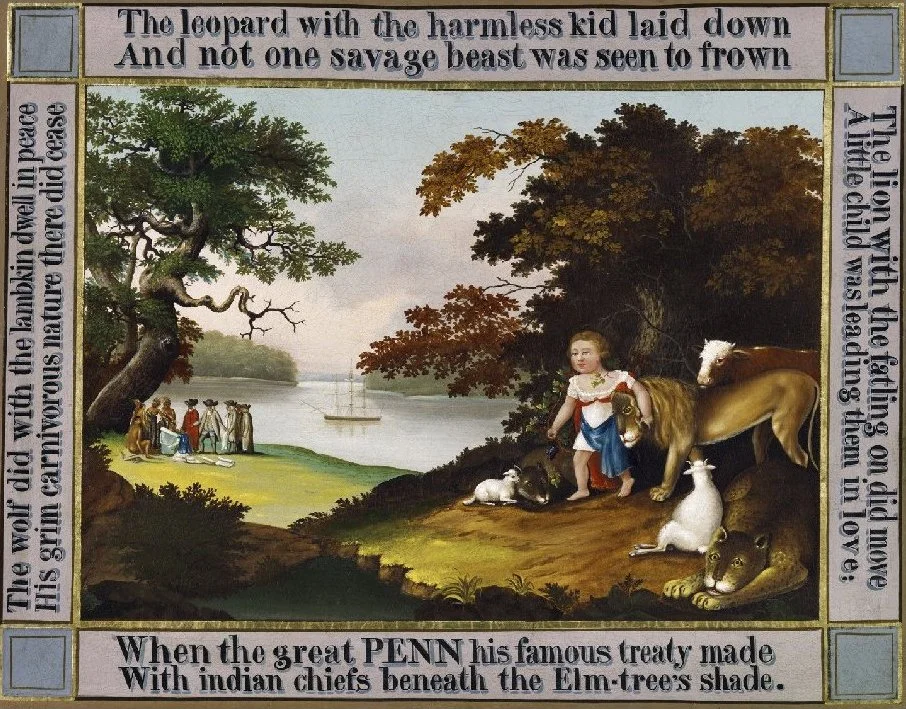
It was a 19th century Pennsylvania artist from Bucks County, Edward Hicks, who made famous the image of the Peaceable Kingdom that Isaiah describes in our reading this morning.  He produced more than sixty versions of the image, depicting the ox and the lion, the leopard and the lamb, and the little child among them who shall lead them.  You probably have a version of one of his paintings filed away in the folk art section of your mind, and perhaps you can picture it now.  Hicks’s paintings look to me like representations of a dream that spring from some deep part of the soul that yearns for God’s righteousness and peace, but knows how distant a hope this is.  And in Advent the church aspires to an impossible task – we try to measure the distance from our wild kingdoms to the peaceable kingdom that God will establish when he shall come to judge the earth.

It may come as a surprise to us every year to be reminded that God is not merely leading us on a safari through a dangerous life in a wild kingdom, and to hear, instead, that God’s will bends toward a peaceable kingdom in which violence, enmity, and discord have no hold, and in which even nature’s teeth and claws have been cleansed and soothed.  The image of the peaceable kingdom haunts us at the outset of the church year, because it points toward a hope that is greater than the quite modest hope that we might learn to be nice to one another – an accomplishment that ought not to have to wait for the end of time, but so often these days among the highest aspirations of the church.  No, the peaceable kingdom is not merely the polite and friendly kingdom.  In the peaceable kingdom of God, the very nature of creation is bent back toward God’s will in the perfection of goodness whence all things sprang into being.  Nor is the peaceable kingdom a vision of heaven, the realms of the courts of God Almighty where angels sing and saints abide.  No, this description is Isaiah’s version of the apocalypse: the revelation of God’s secrets for the earth and its inhabitants that shall come to pass in the fullness of time.

What does it say about our society that entertainment these days is full of apocalyptic visions of zombies and the living dead, but almost nowhere can be found an image of the peaceable kingdom?

If we have convinced ourselves that God’s judgment consists only of punishment, destruction, damnation, and hell, then we have shaped a religion that can have precious little good news; and we are saying a lot more about ourselves than we are about God.  Maybe we are only saying that in the time of judgment we suspect that we’ll get what we deserve.

Back at camp in the Masai Mara, at the end of each afternoon’s ride we were greeted by the smile of the young daughter of our guide: eleven months old, growing up in the African bush, on safari for weeks at a time, in the midst of the wild kingdom.  She could have been a model for the child depicted in Hicks’s expressions of the peaceable kingdom of God.  And in her face one could see the wisdom of God revealed by Isaiah that “a little child shall lead them,” for it is in the face of a child like her that hope is so easily found.

Here we are in the midst of Advent, looking ahead to try to see what God has in store for us.  Taking our cues solely from our immediate environment, it might appear that God is preparing us for a frightening and daring safari through a wild kingdom.  Whether it’s your personal relationships that are a mess, or your spiritual life, of the weather, or the political climate, or your economic reality, or even the state of the church, it can be easy to conclude that you’d better hope you have a steady horse because we are in for a rough ride, and at some point you are going to simply have to hold on and hope you are led to safety.

But thanks be to God for the vision of the peaceable kingdom in which the wolf and the lamb, the leopard and the kid all lie down together; and the calf and the lion and the fatling; and the cow and the bear; and the ox.  To borrow the categories from Charles Dickens, this is not an image of how things may be; no, the vision of the peaceable kingdom is an image of how things will be – according to the divine purposes of God.  All creatures will find peace and harmony, old enmities will be laid to rest, violence will be heard no more, nothing will be hurt or destroyed, and the knowledge of God will be known to the ends of the earth.  And a little child shall lead us into this peaceable kingdom: the child Jesus.

About the second or third day of my safari I said to our guide that I felt I wanted to stop about every forty minutes or so and have a little cry because what I was seeing was so beautiful.  On reflection I have to ask: if the wild kingdom (red in tooth and claw) is that astoundingly beautiful, how beautiful will the peaceable kingdom be (in which righteousness and peace have kissed each other)?  And how will I ever be able to bear such beauty?

We often think that the principal character of God’s people is supposed to be our faithfulness.  But much of the record of religion indicates that the principal character of God’s people is our failure in faith.  We forget that God’s Word is good news to us.  We substitute hope with fear, and no end of misery results.  And we lose sight of the promise of a peaceable kingdom, assuming that the wild kingdom is all that God will ever have in store for us.

So we put our saddles away, and let the horses forget how to lead us to safety.  We build fences and find ways to exterminate the lions, rather than allowing them their space.  And we determine never to go on safari again, so that the only way we can ever see the beauty of God’s creation is through the bars of a zoo, or with the narration of David Attenborough.

Better to skip the zoo and go to the Philadelphia Museum of Art, where you’ll find a painting of Edward Hicks’s – an early version of the peaceable kingdom, with Isaiah’s words painted to frame the entire image:

The wolf shall live with the lamb,

the leopard shall lie down with the kid,

the calf and the lion and the fatling together,

and a little child shall lead them.


Preached by Fr. Sean Mullen

4 December 2016

Saint Mark’s Church, Philadelphia

Ú This episode happened not on safari in the Masai Mara, but in the Laikipia region of Kenya during an afternoon ride, and really should be the basis of its own sermon some day.

Posted on December 12, 2016 .